Fitulator
Body Recomposition Calculator
Body recomposition means losing fat while keeping or building muscle. Start with your number from our body fat calculator, then set a goal below.
More Calculators
Check the Army's 0.55 standard.
Run the Navy's current two-step assessment.
Find out how much of your weight is not fat.
Compare your lean mass for your height.
Check your waist against your height.
See how your fat is distributed.
See the normal ranges for men and women by age.
What Is Body Recomposition?
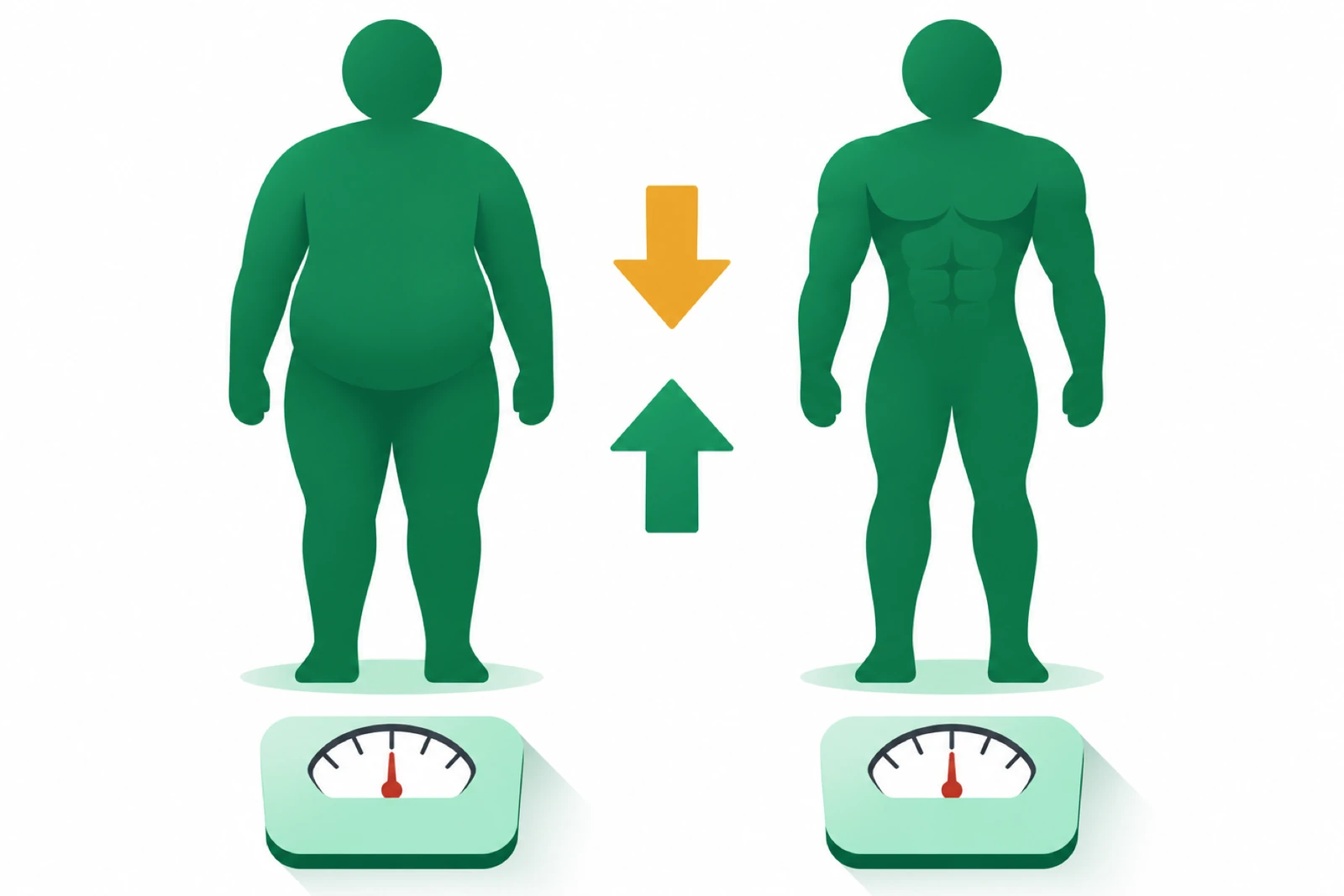
Body recomposition, or body recomp, means changing what your body is made of: less fat, with muscle kept or added. Your weight may change slowly or not at all, so the scale can hide real progress. That is why this calculator starts from your body fat percentage rather than your weight. A body recomp calculator like this one turns that starting point into a goal weight, a calorie target and a protein target.
How This Calculator Works
The calculator first splits your weight into lean mass and fat mass, then works out what you would weigh at your goal if your lean mass stayed the same.
Calorie needs come from the Katch-McArdle equation, which uses lean mass directly, multiplied by your activity level.
Activity factors are 1.375 for light, 1.55 for moderate, and 1.725 for high. The calorie target is set 10% below maintenance. That figure is our chosen starting point, not a rule, because a smaller deficit makes it easier to train hard while you lose fat.
Body recomposition is easiest for beginners and people returning to training. For experienced lifters at low body fat it is slow — and the scale can stay flat while fat falls and muscle rises.
Worked Example
Take a person who weighs 200 lbs at 25% body fat, with a goal of 15%:
- Lean mass: 150 lbs. Fat mass: 50 lbs.
- Goal weight: 150 ÷ 0.85 = 176.5 lbs, which means losing 23.5 lbs of fat.
- At 0.5 to 1 lb of fat a week, that takes about 24 to 48 weeks.
- At moderate activity, maintenance is about 2,850 calories, so the target is about 2,570.
- Protein: at least 145 g a day.
Protein and Training
The protein target in this calculator is 1.6 g per kilogram of body weight. A 2018 meta-analysis found that gains in fat-free mass from resistance training stopped rising above roughly that intake. The studies excluded intentional dieting, so treat it as a minimum during a calorie deficit. Resistance training is what tells your body to keep muscle while you lose fat.
How to run a recomposition
- Set calories just below maintenance — this calculator uses 10% below.
- Eat at least 1.6 g of protein per kilogram of body weight.
- Train with resistance three to four times a week to signal your body to keep muscle.
- Recheck your body fat every few weeks and adjust.
Who Gets the Best Results?
Recomposition tends to be easier for beginners and for people returning to training. Experienced lifters at low body fat usually see much slower changes. Nobody can predict your exact pace, so the timeline here is a planning range and not a promise.
How to Track Progress
- Recheck your number with the body fat calculator every few weeks, under the same conditions.
- Follow your lean mass with the lean body mass calculator. If it drops quickly, your deficit may be too large.
- Use the ffmi calculator to see how your muscularity changes for your height.
Can You Build Muscle and Lose Fat at the Same Time?
Yes — this is the whole point of body recomposition, and it is well documented, especially in people who are new to training, returning after a break, or carrying higher body fat. Those groups can build muscle while in a modest calorie deficit because their bodies are primed to respond. Lean, experienced lifters find it much harder and usually make faster progress by alternating focused muscle-gain and fat-loss phases instead.
Body Recomposition vs Bulking and Cutting
The traditional approach is to “bulk” in a calorie surplus to build muscle, then “cut” in a deficit to reveal it. Recomposition skips the big swings and holds you near maintenance, trading speed for a steadier physique and no large weight gains to reverse. Bulking and cutting can add muscle faster for advanced lifters; recomposition tends to suit beginners, returners and anyone who prefers to avoid big fluctuations.
How Long Does Body Recomposition Take?
Recomposition is slower than a dedicated bulk or cut because you are changing two things at once near maintenance calories. Expect to think in months. Beginners often see clear changes in 8-12 weeks; experienced lifters may need much longer for a visible shift. The scale can barely move the whole time, which is exactly why you track body fat and measurements instead of weight alone.
Signs It Is Working
Because the scale can stay flat, watch other markers:
- Your body fat percentage is slowly falling.
- Your lifts are getting stronger week to week.
- Clothes fit differently — looser at the waist, tighter at the shoulders or legs.
- Progress photos show more definition at a similar weight.
If the scale drops fast and your lifts stall, your deficit is probably too large.
Protein, Training and Recovery
Three inputs decide whether you keep muscle while losing fat. Eat enough protein — around 1.6 g per kilogram of body weight is a sound floor during a deficit. Train with resistance three to four times a week, pushing to add load or reps, which is the signal to retain muscle. And sleep enough, since recovery is when the adaptation happens. Recheck your numbers every few weeks with the body fat calculator and the lean body mass calculator, and adjust.
Frequently Asked Questions
Yes, especially if you are new to resistance training or returning after a break. It gets harder as you become leaner and more experienced.
Not always, but losing a meaningful amount of fat usually requires a modest deficit. That is why this calculator sets its target just below maintenance.
The calculator holds your lean mass steady. If you also gain muscle, you will reach the same body fat percentage at a higher weight.
Every few weeks is enough. As your weight and lean mass change, your calorie and protein targets change too.
Think in months. Beginners often see clear changes in 8-12 weeks; experienced lifters need longer, and the scale may barely move.
Usually a modest one to lose meaningful fat. This calculator sets the target just below maintenance.