Fitulator
Navy Body Fat Calculator
The Navy changed how it assesses Sailors in 2026. This calculator follows the current two-step Body Composition Assessment. For the classic neck-and-waist method, use our body fat calculator.
More Calculators
Check the Army's 0.55 standard.
Find out how much of your weight is not fat.
Compare your lean mass for your height.
Set a goal weight, calorie and protein target.
Check your waist against your height.
See how your fat is distributed.
See the normal ranges for men and women by age.
How the Navy Body Composition Assessment Works Now
The Navy revised its Body Composition Assessment (BCA) for 2026. NAVADMIN 264/25 announced the change, and Guide-4 of the Physical Readiness Program sets out the procedure. Sailors now have height, waist, and weight recorded, and the assessment runs in two steps. Neck measurements are no longer part of it. You may see this tool called the Navy body fat percentage calculator or the US Navy body fat calculator — they all refer to the same official Navy assessment.
Step 1: Waist-to-Height Ratio
The first step is the same for men and women. The waist is divided by height, and the result is cut off at four decimal places.
A Sailor at or below 0.5499 is within standards, and Step 2 is not required. Table 1 of the guide lists the largest waist allowed at each height:
| Height | Maximum waist |
|---|---|
| 62 in | 34 in |
| 64 in | 35 in |
| 66 in | 36 in |
| 68 in | 37 in |
| 70 in | 38 in |
| 72 in | 39.5 in |
| 74 in | 40.5 in |
| 76 in | 41.5 in |
A Sailor at or below a 0.5499 ratio is within standards at Step 1 and skips Step 2. Only those at 0.5500 or higher get a body-fat estimate, where the limit is 26% for men and 36% for women.— MyNavy HR, Guide-4 (June 2026)
Step 2: Body Fat Estimate
A Sailor at 0.5500 or higher moves to Step 2. The Command Fitness Leader subtracts waist from height and looks up that difference against body weight in a table for men or women. The maximum allowable body fat is 26% for men and 36% for women, with no adjustment for age.
The guide publishes Step 2 as lookup tables, not as an equation. To make them usable here, we fitted a straight-line equation to the tables. It matches all 18,700 table values we extracted to within one percentage point, and more than 99% of them exactly.
The assessment, step by step
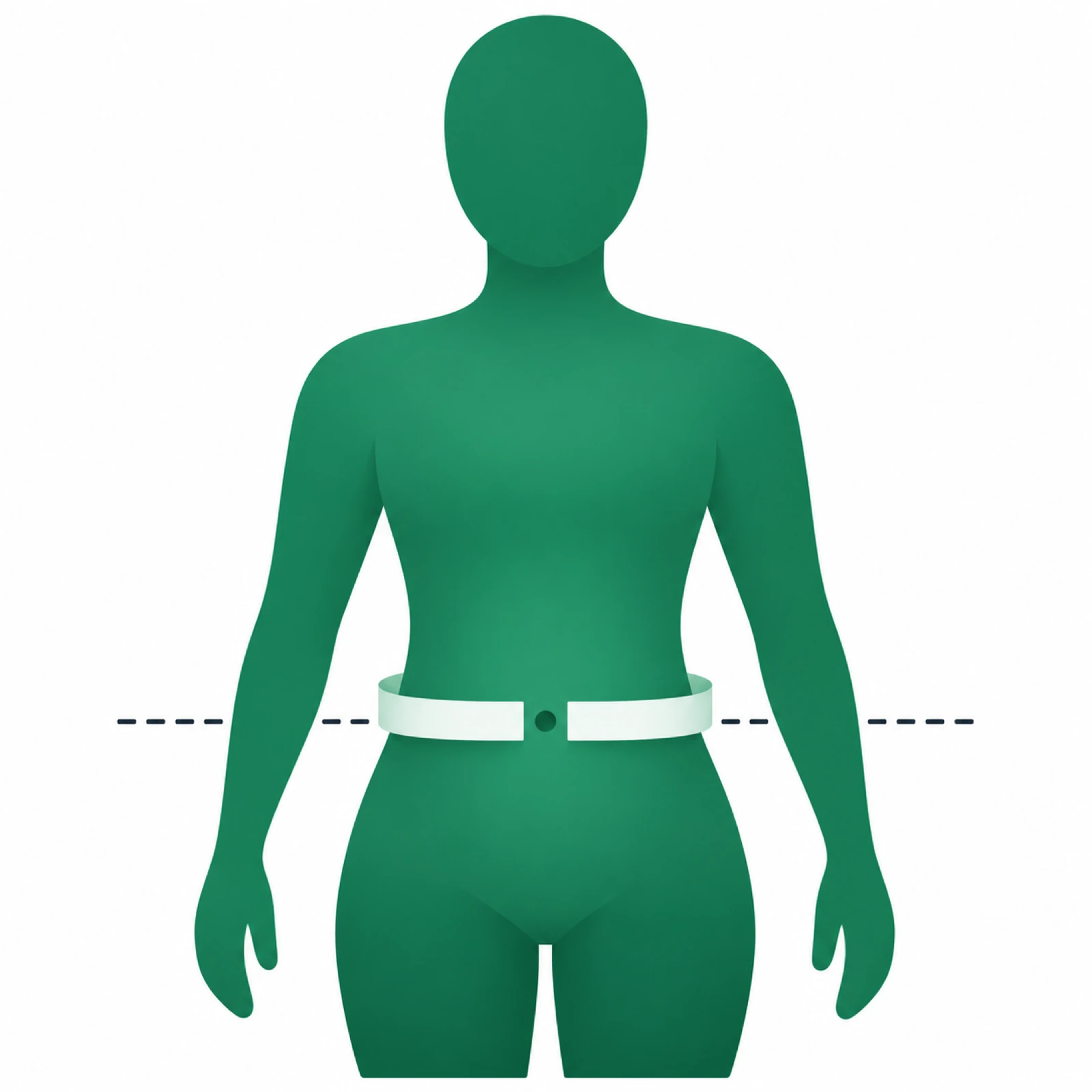
- Record height, waist (at the navel) and weight.
- Step 1 — divide waist by height; a ratio of 0.5499 or lower is a pass.
- Step 2 — if the ratio is 0.5500 or higher, subtract waist from height and look up body fat by weight.
- Compare the result against the 26% (men) or 36% (women) limit.
How Measurements Are Rounded
- Height: rounded up to the nearest half inch.
- Waist: measured at the navel, rounded down to the nearest half inch.
- Weight: rounded to the nearest pound.
This calculator applies the same rounding, so a small change in your input may not change your result.
What Happened to the Neck Formula?
Many sites still call the neck-and-waist equation from Hodgdon and Beckett (1984) the Navy method. It remains a widely used way to estimate body fat, and it is the formula behind our main body fat calculator. It is no longer how the Navy assesses Sailors. The guide also rules out substitutes such as calipers, BMI, and bio-impedance.
Using Your Result
A pass at the Navy limit is not the same as a health target. To see what counts as a healthy body fat percentage outside of military standards, compare your number by age and sex. If you want to track muscle as well as fat, use the lean body mass calculator. Soldiers follow a different rule, covered on the army waist to height ratio calculator.
Navy Body Fat Limits by Sex
At the body-fat step, the Navy’s maximum allowable body fat is 26% for men and 36% for women, and it is not adjusted for age. A Sailor within those limits is Within Standards; a Sailor over them is Not Within Standards, which counts as a failed assessment for the cycle unless they qualify for the High-Performance exception. The first step — the waist-to-height ratio — is sex-neutral, and only Sailors who exceed it move to the body-fat calculation.
What Happens If You Fail the Navy BCA
A Sailor who is Not Within Standards after the official assessment fails the body-composition portion of the Physical Fitness Assessment for that cycle. Repeated failures carry real career consequences, including effects on advancement and, over time, administrative separation. Because of that, the measurement is deliberately standardized — taken by certified Command Fitness Leaders, with retests not authorized once a cycle begins.
Navy vs Army vs Marine Corps Standards
All three services now start with the same waist-to-height idea but apply it differently. The Army uses a ratio below 0.55 as its entire standard. The Navy uses 0.5499 as a first screen, then a body-fat estimate with 26%/36% limits. The Marine Corps screens at 0.52 and then uses a tape test or bioelectrical impedance. You can check the Army’s version on the army waist to height ratio calculator.
Why the Navy Changed Its Method
For decades the services estimated body fat from neck and waist (and hip, for women) circumferences — the method behind our main body fat calculator. A December 2025 Department of War memorandum set a common waist-to-height limit below 0.55 across the force, and the Navy rebuilt its assessment around it for 2026. The newer approach is simpler to administer, sex-neutral at the first step, and aligned with civilian evidence that waist-to-height ratio is a strong health screen.
How to Prepare for the Assessment
The assessment rewards genuine fat loss, not last-minute tricks — the guide explicitly warns against dehydration and other temporary methods. The reliable route is a modest calorie deficit, enough protein, and regular training in the weeks before. To see where you stand ahead of an official measurement, estimate your ratio and body fat here, then compare the result against the body fat percentage chart.
Frequently Asked Questions
The maximum allowable body fat is 26% for men and 36% for women. These limits apply at Step 2, and only if a Sailor is over the Step 1 ratio.
No. The current BCA records height, waist, and weight.
Guide-4 says the official BCA is the first and only one authorized once the command PFA cycle has begun, and that retests are not authorized.
A Sailor outside BCA standards can still pass the overall PFA by scoring Outstanding-Low overall, with Excellent-Medium or higher in all three PRT categories.
No. The current Body Composition Assessment records height, waist and weight, not the neck.
Twice per calendar year for most Sailors, as part of the Physical Fitness Assessment.