Fitulator
Waist to Height Ratio Calculator
Divide your waist by your height and you get one of the simplest health checks there is. Enter both below, then compare the result with our body fat percentage calculator.
More Calculators
Check the Army's 0.55 standard.
Run the Navy's current two-step assessment.
Find out how much of your weight is not fat.
Compare your lean mass for your height.
Set a goal weight, calorie and protein target.
See how your fat is distributed.
See the normal ranges for men and women by age.
What Is Waist-to-Height Ratio?
Waist-to-height ratio, or WHtR, is your waist circumference divided by your height. It is a quick way to estimate central fat, the fat carried around the middle of the body. The UK’s National Institute for Health and Care Excellence (NICE) uses it in its guideline on overweight and obesity.
The simple version is easy to remember: keep your waist to less than half your height.
Waist-to-Height Ratio Formula
The units cancel out, so inches and centimeters give the same answer. A 34-inch waist at 70 inches tall gives a ratio of 0.49.
NICE guideline NG246 applies these bands to adults with a BMI under 35. The simple rule: keep your waist to less than half your height.
Waist-to-Height Ratio Chart
| Ratio | NICE classification |
|---|---|
| 0.40-0.49 | Healthy central adiposity |
| 0.50-0.59 | Increased central adiposity |
| 0.60 or more | High central adiposity |
NICE applies these bands to adults with a BMI under 35. A ratio below 0.40 falls outside the healthy band, so it is worth checking your measurements and talking to a clinician if it is correct.
Waist Size by Height
| Height | Ratio 0.50 | Ratio 0.60 |
|---|---|---|
| 5’0″ (60 in) | 30.0 in | 36.0 in |
| 5’4″ (64 in) | 32.0 in | 38.4 in |
| 5’8″ (68 in) | 34.0 in | 40.8 in |
| 6’0″ (72 in) | 36.0 in | 43.2 in |
| 6’4″ (76 in) | 38.0 in | 45.6 in |
How to Measure Correctly
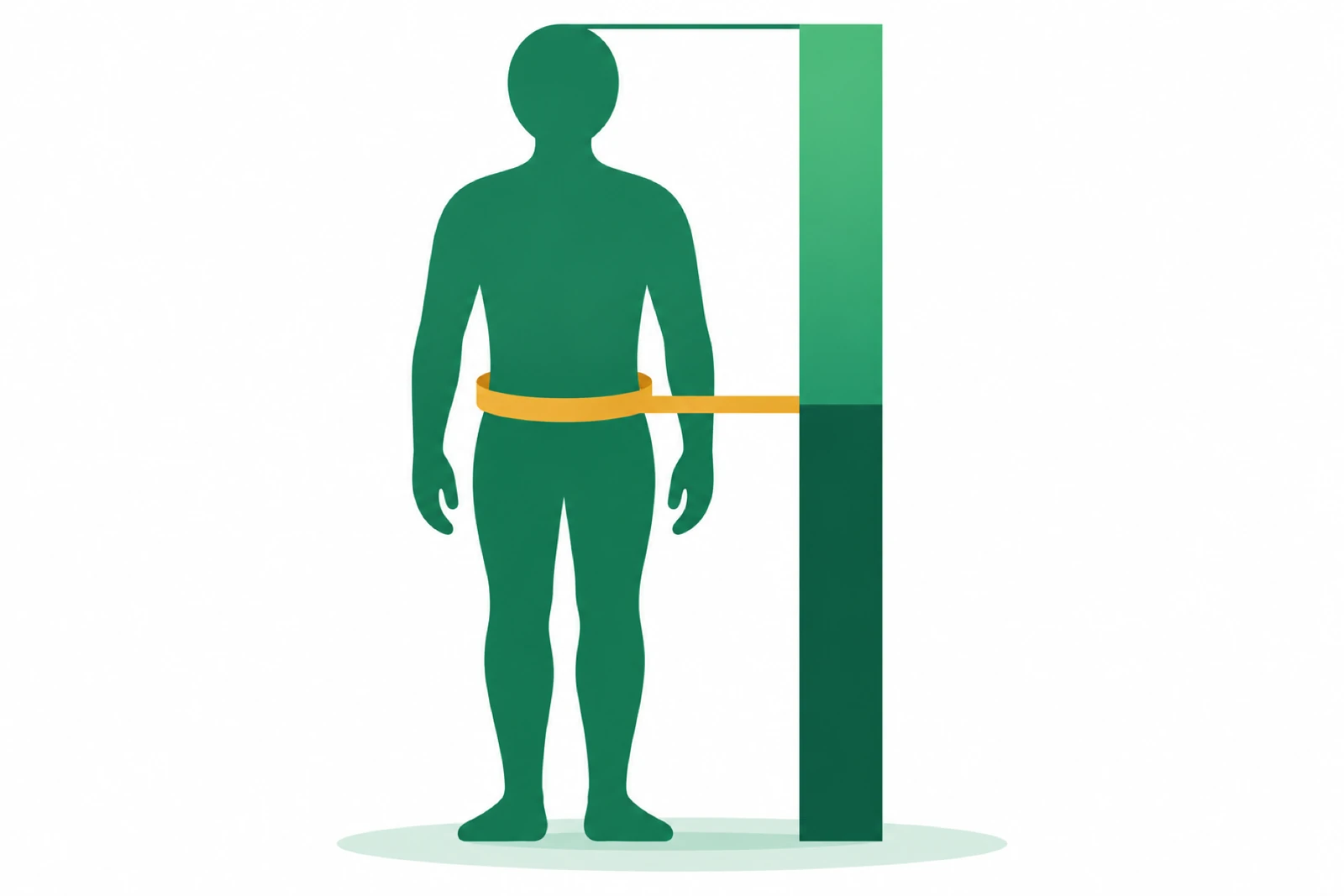
- Stand straight and find the bottom of your ribs and the top of your hip bone.
- Wrap the tape midway between those two points, level all the way around.
- Breathe out normally and read the tape. Do not pull it tight or hold your stomach in.
- Measure your height without shoes, using the same unit.
Military standards measure at the navel instead, so your result may differ slightly. Whichever point you choose, use the same one each time you track your progress.
Waist-to-Height Ratio in the U.S. Military
A December 2025 memorandum on military fitness standards set an upper limit below 0.55 across the services, and each service applies it in its own way. The Army uses it as its only body composition measure, which you can check with the army whtr calculator. The Marine Corps uses a screening limit of 0.52 or lower, followed by a body fat evaluation for Marines above it.
What This Ratio Does Not Tell You
WHtR says nothing about how much of your weight is muscle, and it ignores fat stored elsewhere on the body. To see where you stand overall, compare your body fat result against the body fat percentage chart. To see how your fat is distributed between your waist and hips, use the waist to hip ratio calculator.
Why Waist-to-Height Beats BMI and Waist Alone
A plain waist measurement ignores the fact that a 34-inch waist means something different on someone 5’2″ than on someone 6’4″. Dividing waist by height corrects for that, which is why waist-to-height ratio often predicts cardiometabolic risk better than either BMI or waist circumference on its own. BMI can miss central fat entirely; a lean, tall person and a shorter, apple-shaped person can share a BMI while carrying very different amounts of belly fat.
Health Risks of a High Ratio
A ratio in the higher bands reflects more fat around the middle, much of it visceral fat around the organs. That pattern is linked to higher risk of heart disease, type 2 diabetes, high blood pressure and stroke. The strength of waist-to-height ratio is how early it flags this — often while BMI still looks normal — which is why clinicians use it as a quick screen.
Waist-to-Height Ratio for Children
The “keep your waist under half your height” rule is attractive because it works across adults regardless of age or sex, and the same 0.5 boundary is often applied to children and teens as a simple screen. Growth and puberty complicate the picture, though, so for a child a clinician will read the ratio alongside growth charts rather than treating 0.5 as a hard line.
How to Lower Your Waist-to-Height Ratio
Your height is fixed, so the ratio moves only when your waist does. Abdominal fat usually responds early to:
- A modest calorie deficit maintained consistently.
- A mix of cardio and resistance training.
- Higher protein and better sleep to protect muscle while fat comes off.
- Less alcohol and ultra-processed food.
Measure at the same point each time — the belly button for military-style checks, or midway between the lowest rib and hip bone for the civilian version — and track the trend.
Where the Military Uses It
The same ratio now sits at the center of U.S. military body-composition rules. The Army uses a limit below 0.55 as its sole standard, which you can check with the army waist to height ratio calculator, and the Navy uses it as the first step of its assessment on the navy body fat calculator. For how much fat you carry overall, compare your result with the body fat percentage chart.
Frequently Asked Questions
NICE classes 0.40 to 0.49 as healthy. In plain terms, your waist should be less than half your height.
NICE uses the same bands for both, which is one reason this measure is so simple to use.
Divide your waist measurement by your height, using the same unit for both. A 32-inch waist at 68 inches tall gives 0.47.
It tells you something BMI cannot, because BMI has no idea where you carry fat. NICE uses the two together rather than treating one as a replacement.
NICE classes 0.40-0.49 as healthy. The simple rule is to keep your waist under half your height.
Your height is fixed, so reduce abdominal fat through a calorie deficit and regular training; the ratio falls as your waist does.