Fitulator
Waist to Hip Ratio Calculator
Your waist-to-hip ratio shows where you store fat, not just how much. For total body fat, pair it with our body fat percentage calculator.
More Calculators
Check the Army's 0.55 standard.
Run the Navy's current two-step assessment.
Find out how much of your weight is not fat.
Compare your lean mass for your height.
Set a goal weight, calorie and protein target.
Check your waist against your height.
See the normal ranges for men and women by age.
What Is Waist-to-Hip Ratio?
Waist-to-hip ratio, or WHR, compares the size of your waist with the size of your hips. It shows how your body stores fat. People who carry more fat around the middle generally face more health risk than people who carry it on the hips and thighs.
Waist-to-Hip Ratio Formula
A 32-inch waist with 40-inch hips gives a ratio of 0.80.
The World Health Organization lists a waist-to-hip ratio at or above 0.90 in men and 0.85 in women as a substantially increased risk of metabolic complications.— WHO expert consultation
Waist-to-Hip Ratio Chart
The World Health Organization’s expert consultation report lists these levels as a substantially increased risk of metabolic complications:
| Sex | Substantially increased risk |
|---|---|
| Men | 0.90 or higher |
| Women | 0.85 or higher |
Different ratios are sometimes used for particular populations, and a result near the line matters less than the direction it moves over time.
How to Measure Waist and Hips
- Stand with your feet close together and your arms at your sides.
- For your waist, wrap the tape midway between your lowest rib and the top of your hip bone.
- For your hips, wrap the tape around the widest part of your buttocks.
- Keep the tape level and snug without pressing into the skin, and read it at the end of a normal breath.
Waist-to-Hip Ratio vs. Waist-to-Height Ratio
WHR can look healthy in someone with both a large waist and large hips, because it only compares the two. The waist to height ratio measures your waist against a fixed reference instead, and it needs only one tape measurement. Many people find it useful to check both.
What This Ratio Does Not Tell You
WHR shows fat distribution, not how much fat you have. To estimate total fat, compare your number from the calculator above with the body fat chart.
Apple vs Pear: Why Fat Distribution Matters
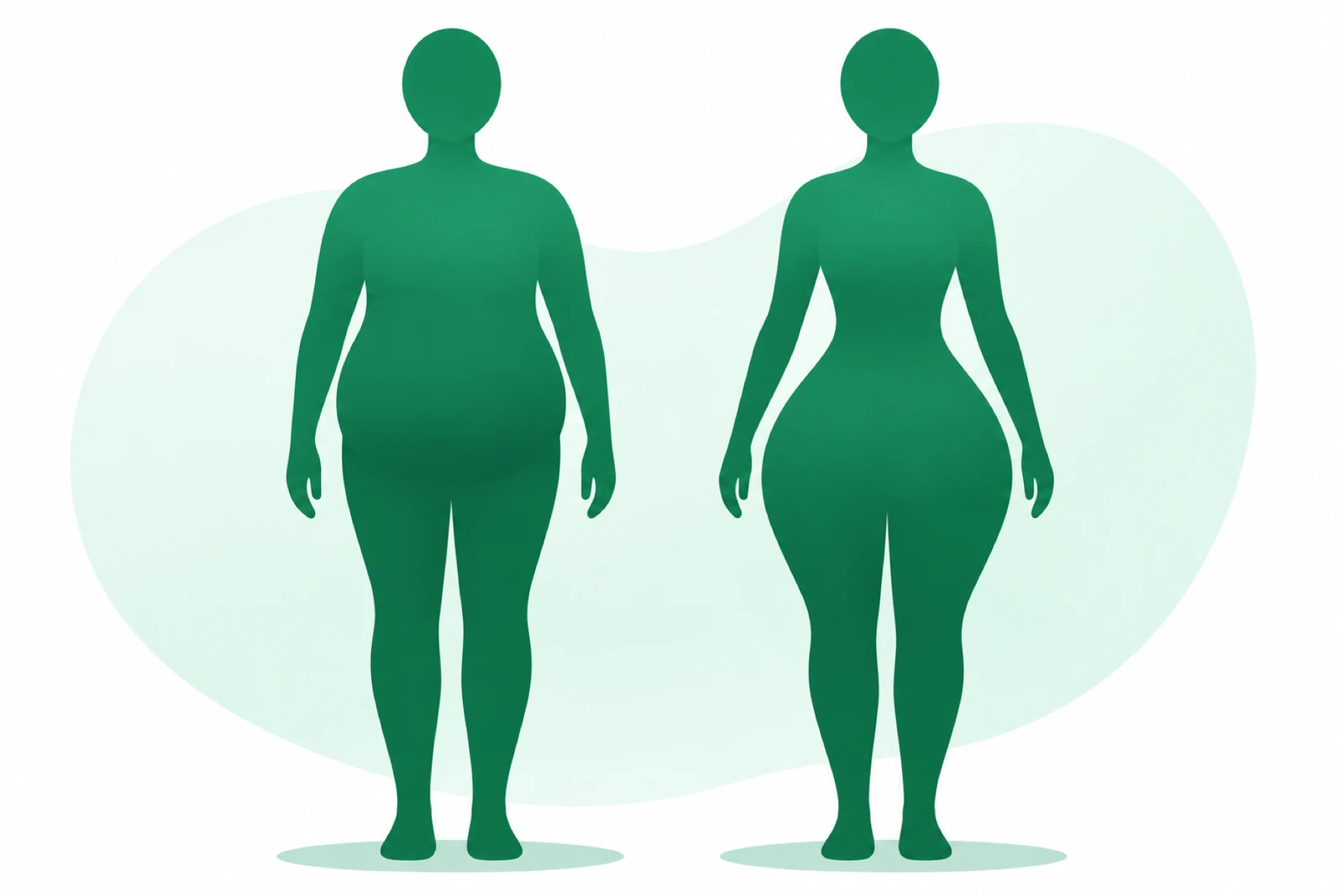
Two people can carry the same amount of fat and face very different health risks, depending on where that fat sits. Waist-to-hip ratio captures this in a single number. A higher ratio means more fat around the abdomen — the “apple” (android) shape — while a lower ratio means more fat on the hips and thighs — the “pear” (gynoid) shape.
Abdominal fat is more metabolically active than hip fat. Much of it is visceral fat, packed around the organs, and it releases fatty acids and inflammatory signals straight into the bloodstream. That is why an apple shape is linked to higher risk even at a normal weight — and why your ratio can tell you something the scale alone cannot.
What a High Waist-to-Hip Ratio Means for Your Health
Research consistently links a higher waist-to-hip ratio to a greater risk of heart disease, type 2 diabetes, high blood pressure and metabolic syndrome. In several large studies it predicts heart-attack risk better than BMI. The World Health Organization treats a ratio at or above 0.90 in men and 0.85 in women as a substantially increased risk of metabolic complications.
A ratio below those cut-offs does not guarantee good health, and one reading matters far less than the direction it moves over time. Treat it as a single signal alongside blood pressure, blood sugar and how your waist changes month to month.
Waist-to-Hip Ratio by Sex
Men and women store fat differently, which is why the cut-offs differ. Women naturally carry more fat on the hips and thighs, which lowers the ratio, so their threshold (0.85) sits below men’s (0.90). Within each sex the ratio tends to drift upward with age as fat redistributes toward the middle — one reason the same waist measurement can mean more at 55 than at 25.
How to Lower Your Waist-to-Hip Ratio
Your hip measurement is mostly set by bone structure and will not change much, so lowering your ratio means reducing fat around the waist. There is no way to spot-reduce belly fat; it comes off as part of overall fat loss. The levers that actually work:
- A modest calorie deficit — visceral fat is often the first fat to go when you lose weight.
- Regular activity that combines cardio with resistance training.
- Enough protein and sleep, which help preserve muscle while you lose fat.
- Limiting alcohol and heavily processed food, which tend to add abdominal fat.
Re-measure every few weeks under the same conditions to follow the trend rather than the daily noise.
Common Measuring Mistakes
Small errors change your ratio more than you would expect. The most common ones:
- Measuring the waist at the belly button instead of the narrowest point, which inflates the number.
- Pulling the tape tight or holding your stomach in.
- Measuring the hips too high, above the widest part of the buttocks.
- Measuring over bulky clothing.
Use a non-stretch tape, keep it level all the way around, breathe out normally and take each measurement twice.
Waist-to-Hip Ratio vs BMI and Waist-to-Height
BMI only compares weight to height — it has no idea where you carry fat, so someone with an apple shape can have a “normal” BMI and still be at risk. Waist-to-hip ratio fixes that by looking at shape. The waist-to-height ratio is an even simpler alternative that needs just one measurement and is easy to track, while the body fat percentage chart tells you how much fat you carry overall. Many people check all three: how much fat, where it sits, and how it compares to their height.
Frequently Asked Questions
Under the WHO levels, the risk threshold is 0.90 for men and 0.85 for women, so a lower number sits below that line.
Men and women store fat differently. Women tend to carry more on the hips, which lowers the ratio, so the cut-off is lower for them.
Divide your waist measurement by your hip measurement, using the same unit for both.
Your bone structure sets part of it, but losing abdominal fat lowers your waist measurement and with it your ratio.
For risk tied to belly fat, often yes — BMI cannot tell where you store fat. Many clinicians use both together.
You can lower it by reducing abdominal fat through a calorie deficit and training. Your hip size is largely fixed by bone structure.